
Harnett County Clerk Contact
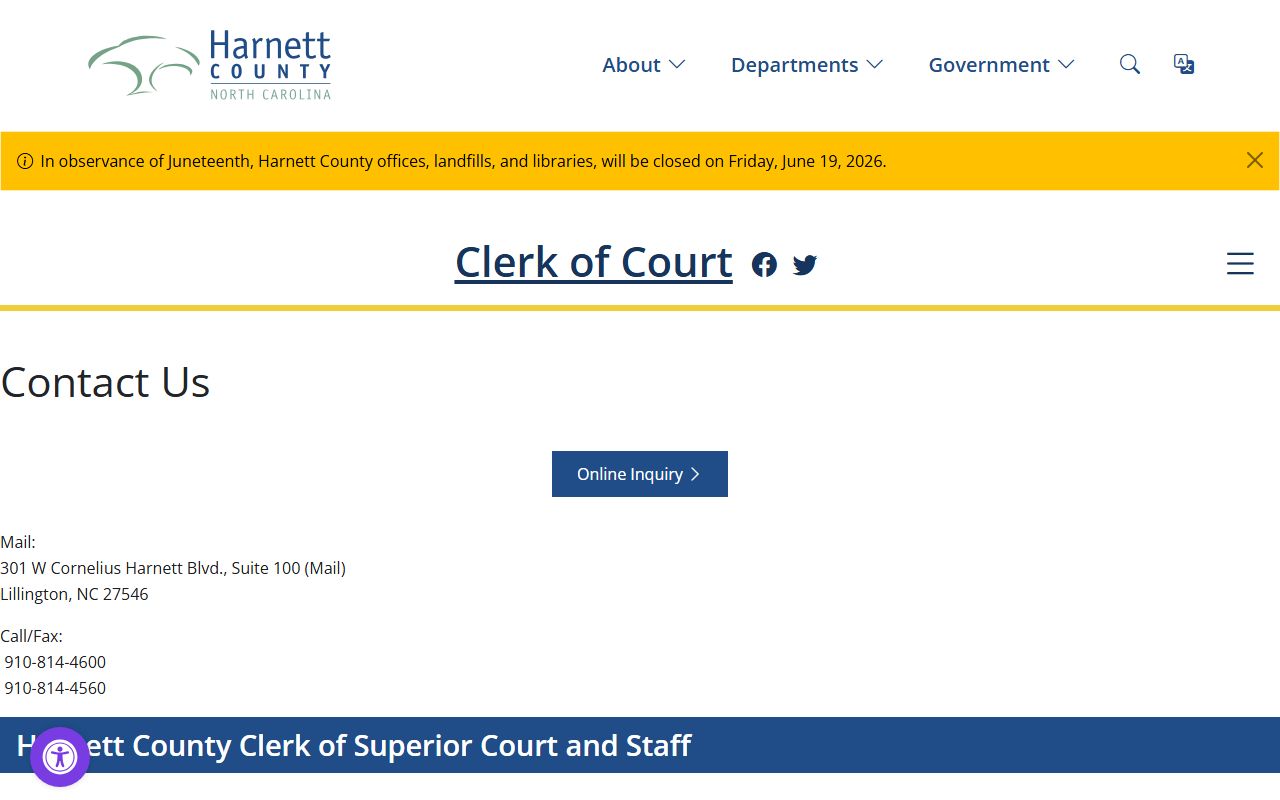
The current Harnett County Clerk of Superior Court listed in the local Clerk materials is Renee Whittenton. The Clerk's office is at the Harnett County Courthouse, 301 W. Cornelius Harnett Blvd., Suite 100, Lillington, NC 27546. The main Clerk phone is 910-814-4600, and the fax listed on the local Clerk site is 910-814-4560. The NC Judicial Branch courthouse page notes a daily lunch closure from 12:30 p.m. to 1:30 p.m.
The official court contact directory gives direct department numbers: Civil 910-814-4632, Criminal 910-814-4588, Estates/Special Proceedings 910-814-4640, Juvenile Court 910-814-4605, Bookkeeping/Cashier 910-814-4555, Magistrates-Civil 910-814-4499, and Magistrates-Criminal 910-893-0242.
Clerk of Superior Court
Clerk: Renee Whittenton
301 W. Cornelius Harnett Blvd., Suite 100
Lillington, NC 27546
910-814-4600
Fax: 910-814-4560
Lunch closure: 12:30 p.m. to 1:30 p.m.
The Harnett Clerk contact page is the local source for the Clerk office and staff contacts.
The department-specific phone numbers are often more useful than a general search portal when a user needs copies, certified checks, or a status question answered by the correct division.
What the Clerk Does in Harnett County
The local Clerk responsibilities page describes four main roles: Probate Judge, Record Keeper, Administrator, and Comptroller. In practical record terms, the office receives and maintains court filings, indexes and processes foreclosure documents, supports civil and criminal divisions, administers estates and special proceedings, and handles cashier/bookkeeping functions for court costs and payments.
- Maintain Harnett civil, criminal, estate, special proceeding, and foreclosure records filed with the court.
- Provide public terminal access for civil, special proceeding, and estates case information where public access is allowed.
- Act as probate judge for wills, estates, and some special proceedings under North Carolina clerk authority.
- Collect court costs, fines, fees, and payments through the cashier/bookkeeping function.
How to Request a Certified Copy
Certified court copies are used when a document must be proven as an official court record, such as a judgment, divorce decree, estate order, or criminal record check. The NC Judicial Branch says a case file can be viewed by visiting the clerk in the county where the case is located, and staff can provide copies for a fee. Harnett's Clerk materials also describe a certified criminal record check by name for a statutory $25 fee.
- Search the NC eCourts Portal first if the case number or record number is unknown.
- Identify the division: Civil, Criminal, Estates/Special Proceedings, Juvenile, or Bookkeeping/Cashier.
- Call the division before visiting if the record may be sealed, restricted, older, or not fully digitized.
- Provide the case number, party names, document name, and requested copy type to clerk staff.
- Pay the applicable copy or certified-check fee and follow pickup or mail instructions from the Clerk.
Records Request Form Fields
No Harnett-specific general court record request form was located in the research file. A useful request should still include enough detail for clerk staff to identify the file without guessing. The Portal field inventory also supports the same identifiers: record number, party name, citation number, attorney information, business name, file date, and Harnett County as location.
| Field | Required | Notes |
|---|---|---|
| Case or record number | Recommended | Best identifier when known; Portal Smart Search accepts record numbers. |
| Party names | Yes | Use last, first middle suffix format where possible. |
| Division or case type | Recommended | Civil, criminal, estates, juvenile, special proceeding, traffic, or family helps route the request. |
| Document type | Yes | Examples: judgment, divorce decree, order, will, letters, disposition, or certified criminal check. |
| Copy type and quantity | Yes | State whether plain or certified copies are needed and how many copies are requested. |
| Requester contact | Yes | Include phone, mailing address, and any deadline so staff can clarify fees or restrictions. |
Harnett County Clerk Fees
The research file gives some specific Clerk payment facts and directs users to current NC Judicial Branch court-cost charts for amounts that vary by case type. Do not assume the same amount applies across civil, criminal, estates, traffic, and special proceeding filings.
| Item | Amount |
|---|---|
| Certified Harnett criminal record check | $25 statutory fee |
| Public terminal inquiry-only criminal name check | No charge |
| Court copies | Fee applies through clerk staff |
| Court costs | Vary by case type; use current NC Judicial Branch charts |
| Mail payments | Money order or certified check only; no cash or personal checks by mail |
The North Carolina public-records statute at G.S. 132-1 provides the broad public-records policy for North Carolina public agencies, while court-record access also depends on judicial record rules and confidentiality limits.
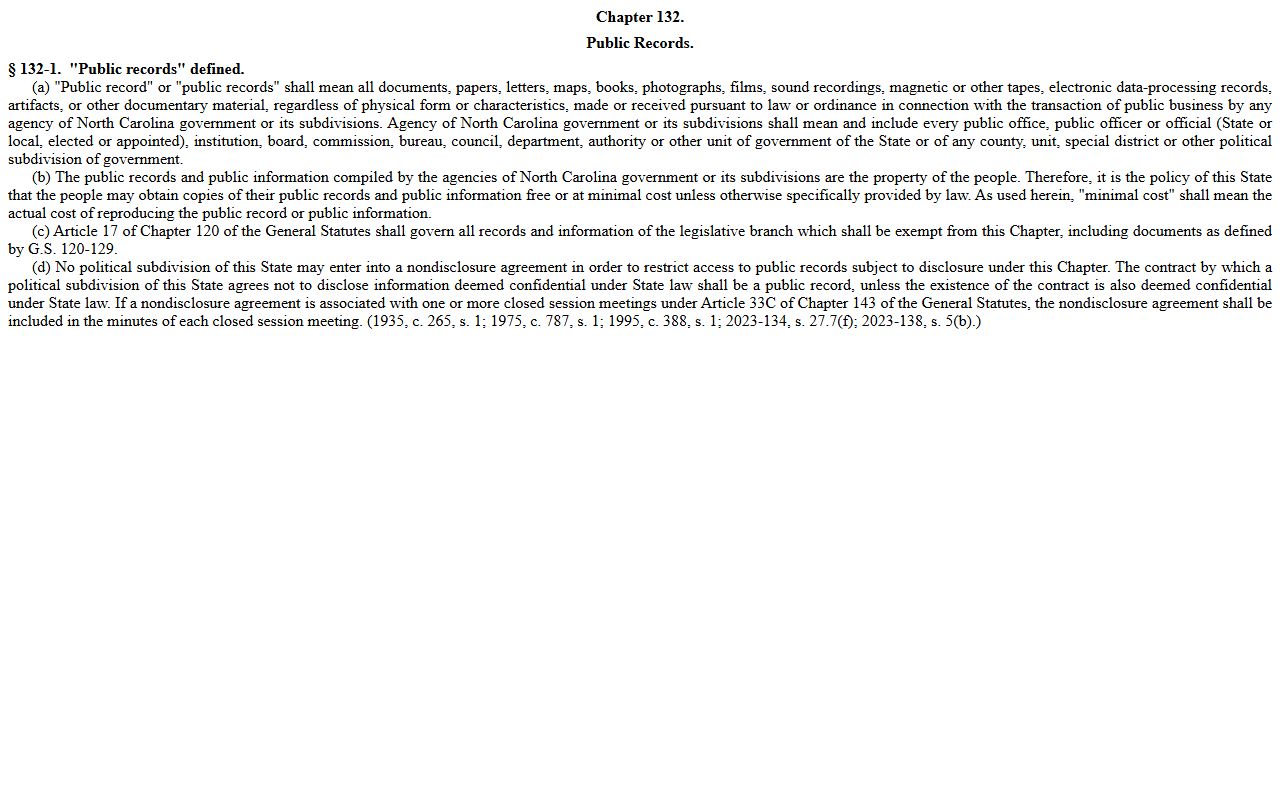
The statute supports access principles, but a Clerk file can still contain sealed, juvenile, mental-health, or otherwise restricted information.
Common Clerk Forms
Harnett's local rules and forms page directs users to local rules and courthouse personnel when specific local forms are not posted. For statewide court forms, use NC Judicial Branch form resources, Guide & File where available, and the eCourts filing tools for supported case types.
- Harnett local rules and forms - local rules, local forms if posted, and courthouse guidance.
- NC Judicial Branch services - statewide online services, forms, payments, and filing tools.
- File & Serve - electronic filing in eCourts counties.
Mail and Online Filings
Harnett is an eCourts county. The local Clerk eCourts page describes the statewide technology suite as including Portal, File & Serve, Guide & File, and Odyssey. Portal allows public users to search court records, hearings, documents, and payments. Registration is not required to view publicly available information, but registration is required for saved cases and elevated access. Elevated access is limited to users with verified business need and statutory authority.
The Harnett eCourts page explains the local transition into Portal, File & Serve, Guide & File, and Odyssey.
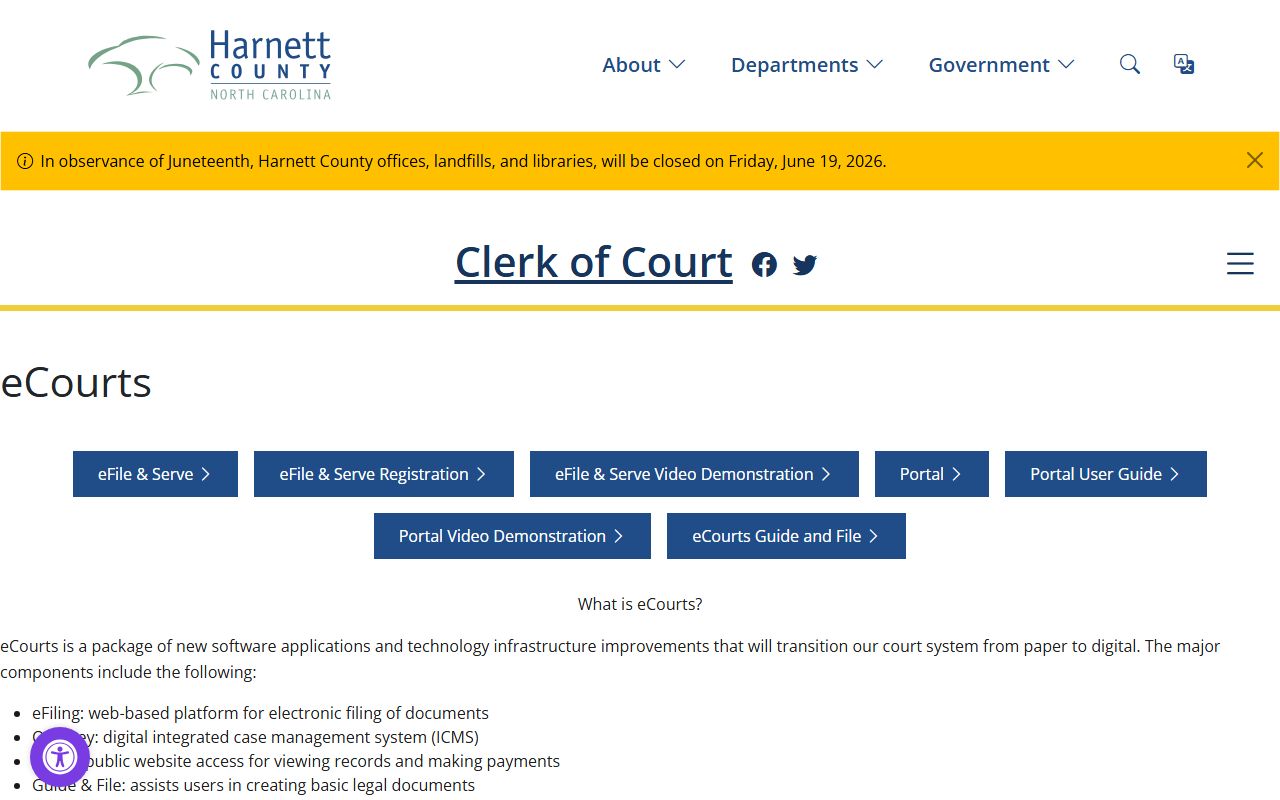
The eCourts status is central to Harnett record access because public search and filing now depend on statewide systems rather than a stand-alone county database.
The Harnett eFile and Serve page describes electronic filing, file-stamped copies, fee payment, and status updates.
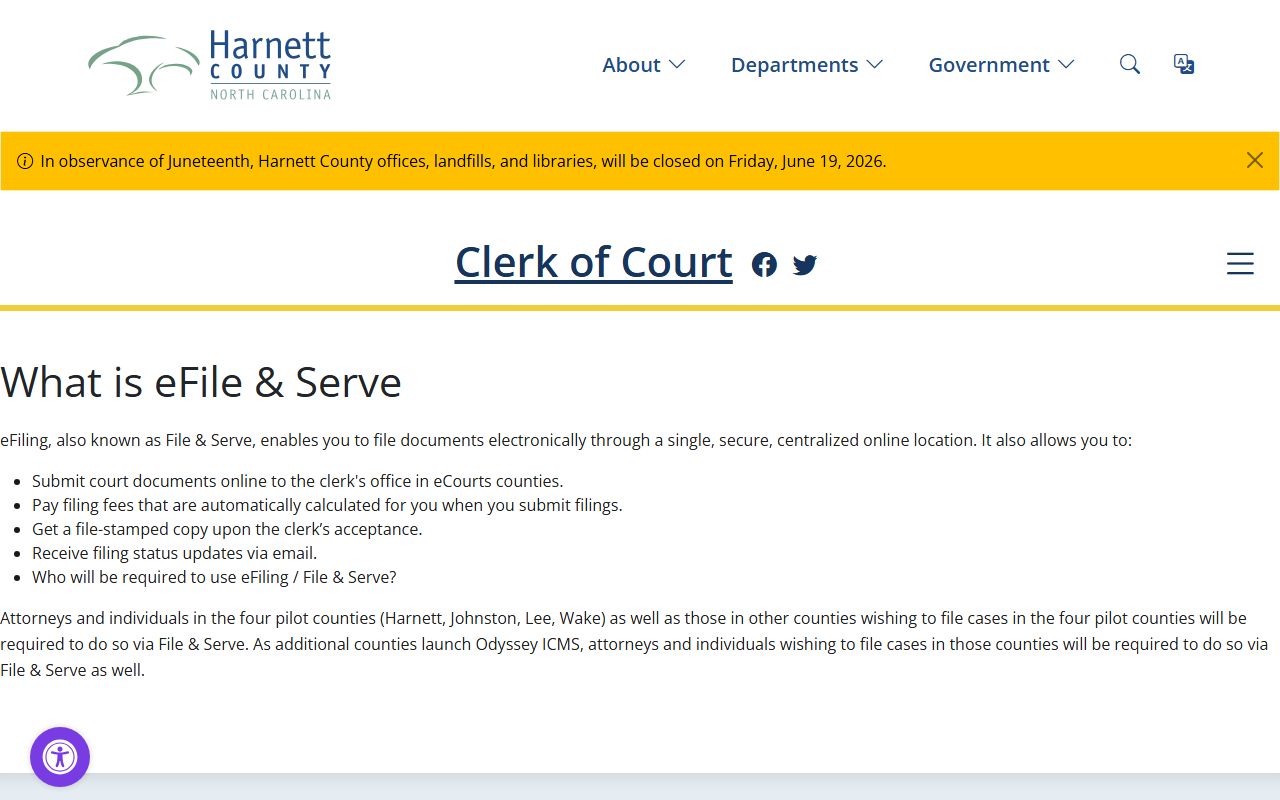
For mail payments, Harnett payment information says to use a money order or certified check payable to Harnett County Clerk of Superior Court and mail it to Clerk of Superior Court, Harnett County Courthouse, attn: Cashier's Office, 301 W. Cornelius Harnett Blvd., Suite 100, Lillington, NC 27546. No cash and no personal checks are accepted by mail.
Clerk Records Versus Register of Deeds Records
Harnett County has a unified court clerk for trial-court records, but the Register of Deeds is a separate office. The Clerk of Superior Court is the record keeper for civil cases, criminal cases, estates, special proceedings, foreclosures, juvenile court records where access is permitted, and court financial records. The Register of Deeds handles marriage licenses, marriage certificates, birth and death certificates, real estate instruments, notary public commissions, assumed names, military discharges, plats, powers of attorney, and other recorded documents.
This split affects the access channel. A divorce decree is a court judgment and belongs with the Clerk or Portal. A marriage certificate is a Register record. A foreclosure special proceeding is a clerk/court record. A deed of trust, cancellation, or recorded plat is a Register record. A certified Harnett criminal record check uses the Clerk's criminal-record process, while a sheriff incident report or investigative record follows the law-enforcement public-record route and may be limited by criminal-investigation rules.
When Portal does not answer the question, direct the follow-up by division. Civil case files and divorce copy questions go to Civil at 910-814-4632. Criminal case files, charge dispositions, and certified criminal checks go to Criminal at 910-814-4588 or the Clerk main line. Estates and probate questions go to Estates/Special Proceedings at 910-814-4640. Payment questions can route to Bookkeeping/Cashier at 910-814-4555.
Portal searches are statewide, so Harnett users should always apply the Harnett County location filter before treating results as local. Smart Search can use party name, record number, citation number, attorney bar number, attorney name, business name, case cross-reference number, or nickname. Hearing searches can use case number, party name, business name, attorney name, attorney bar number, judicial officer, or courtroom. If the search works but the document is not visible, the Clerk's office is still the correct local copy channel.
Public access also depends on the record category. Civil, special proceeding, and estate case information can be available on public terminals, while juvenile, adoption, sealed, expunged, mental-health, and protected personal information may be withheld. The Clerk can explain the access route, but clerk staff cannot turn a restricted record into a public record simply because a requester knows the case number.
For courthouse visits, account for the daily 12:30 p.m. to 1:30 p.m. lunch closure and bring enough identifying case information to avoid a broad name-only search when the request involves common names.