
Harnett County Court Dockets
A docket is the court's running list of case events, scheduled hearings, and key entries. In Harnett County, docket information can appear through Portal Search Hearings, local administrative schedules, civil and criminal calendars, and public calendar PDFs. A docket may show the court date, time, courtroom, judge, prosecutor, courtroom clerk, case number, party name, offense or case type, and fields for plea, verdict, or judgment. It usually does not show the full document set in the case file.
Harnett County uses North Carolina's unified trial-court structure. Superior Court hears felony criminal matters, larger civil cases, and appeals from District Court. District Court hears misdemeanors, infractions, juvenile matters, domestic cases, small claims, magistrate-related matters, and many traffic cases. That division matters because a docket entry can be a District Court traffic calendar, a criminal disposition calendar, a civil hearing, or a Superior Court matter. The full case file remains a broader Harnett County court records issue.
- Docket
- A list or sequence of filings, hearings, and events in a case.
- Calendar
- A schedule of cases set for a particular date, courtroom, or session.
- Disposition
- The result of a charge or case event, such as dismissed, guilty, responsible, or judgment entered.
Search Harnett County Court Dockets Online
The main online route for Harnett County court dockets is Portal Search Hearings. The hearing tool allows searches by location, hearing type, case number, party name, business name, attorney name, attorney bar number, judicial officer, or courtroom. Harnett County must be selected as the location because Portal is statewide. Local schedule pages also matter because the NC Judicial Branch posts Harnett administrative schedules, local rules, and court news separately from the Portal search interface.
- Open the Portal dashboard or the Search Hearings tile.
- Select Harnett County under location before running a name or case-number search.
- Choose All Hearing Types, Civil, Criminal, Family, or Probate or Mental Health based on the case type.
- Search by party name, case number, business name, attorney, judicial officer, or courtroom.
- Confirm the hearing site because Harnett has the main courthouse in Lillington and a Dunn Court Annex.
The Harnett local administrative schedules page is the county-level calendar source for civil calendars, criminal calendars, and court date search links.
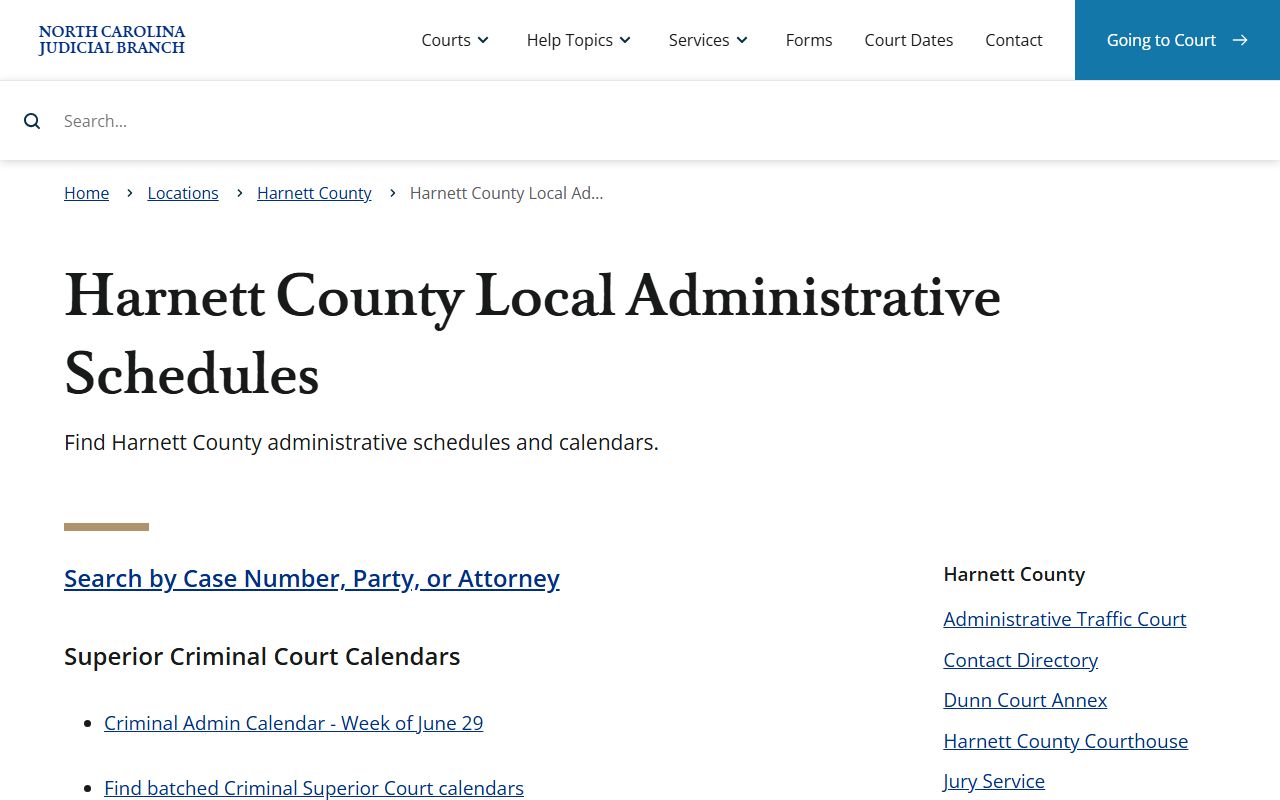
Those local schedules are important because a docket search may begin in Portal but still need county calendar context before someone travels to court.
Harnett County Court Docket Fields
Portal Search Hearings has its own field structure. A user can search broadly by location and hearing type, then narrow by party name or case number. A courtroom search can help when a docket is tied to a particular room, while attorney and judicial-officer searches are useful when the party name is uncertain. The statewide tool exposes many counties and officers, so Harnett filtering is the key step.
| Field Label | Type | Required | Options / Format Notes |
|---|---|---|---|
| Select Location | Dropdown | Yes | Choose Harnett County or the search may return statewide results. |
| Select Hearing Types | Dropdown | Yes | All Hearing Types, Civil, Criminal, Family, or Probate or Mental Health. |
| Select Search Types | Dropdown | Yes | Case Number, Party Name, Business Name, Attorney Name, Attorney Bar Number, Judicial Officer, or Courtroom. |
| Party Name | Text | Conditional | Last name, first name, and optional middle name; Sounds Like can be used. |
| Judicial Officer | Dropdown | Conditional | Statewide officer list appears when that search type is chosen. |
| Courtroom | Dropdown/Text | Conditional | Useful when a posted calendar identifies a courtroom. |
Portal docket searches do not replace official court instructions. If a docket entry appears unclear or a hearing location has changed, the Harnett County contact directory lists the Clerk, civil, criminal, estates, juvenile, magistrate, and District Attorney phone lines. Calling the correct division is often faster than guessing from a docket abbreviation.
Sample Harnett County Docket Entry
Research from an official Harnett criminal disposition calendar shows how a public docket can be structured. The header identifies the General Court of Justice, location in Lillington, District Court Division, Harnett County, court date, time, courtroom number, and calendar type. Staff fields can include judge presiding, courtroom clerk, and prosecutor. Case lines can include the defendant, offense, complainant or officer, file number, plea, verdict, class, and judgment.
| Field | What It Shows |
|---|---|
| Court date and time | The session date and start time for the docket or calendar. |
| Courtroom number | The courtroom assigned to the hearing, such as the number shown on the calendar. |
| Judge / clerk / prosecutor | The court staff and prosecutor assigned to that session when listed. |
| Defendant or party name | The person or business tied to the scheduled matter. |
| Offense or case type | The charge, infraction, traffic offense, civil issue, or hearing type. |
| File number | The court identifier used to match the docket line to the case file. |
| Plea, verdict, judgment | Fields that may be blank before court and completed after action is taken. |
The sample calendar included traffic examples such as speeding, driving while license revoked not impaired revocation, no operator's license, no motorcycle endorsement, reckless driving to endanger, and expired operator's license. Public calendar entries do not display Social Security numbers, full birth dates, full addresses, or private financial data.
Harnett County Courts With Dockets
Harnett County docket information flows from the same state court structure that creates the case file. The North Carolina courts page describes Superior Court, District Court, appellate courts, small claims, and recovery courts. In Harnett, Superior Court and District Court are both part of District 12, and both use the statewide case system. Magistrate and small claims matters are tied to District Court and clerk records rather than a county-run municipal court database.
- Superior Court handles felonies, civil cases over $25,000, and appeals from District Court.
- District Court handles misdemeanors, infractions, juvenile, domestic, traffic, civil, and magistrate-related matters.
- Administrative Traffic Court handles infractions and minor traffic offenses through Disposition Court procedures.
- Probate and special proceedings are handled through the Clerk of Superior Court, with probate or mental health hearing filters in Portal.
The Harnett local rules and forms page is a useful companion to docket review because local forms, standing rules, or courthouse instructions can affect how a scheduled matter proceeds.
Local rules do not replace the docket, but they help explain why a Harnett County hearing may be scheduled or managed a certain way.
The state court hierarchy source provides the broader map for understanding where Harnett County dockets fit in North Carolina.
The hierarchy is especially useful when a docket line shows District Court, Superior Court, magistrate, or appellate language.
Harnett Dockets vs Case Records
A Harnett County docket is narrower than a full case file. The docket tells when something is scheduled, what happened procedurally, or which courtroom and officer are connected to the event. The case file may include pleadings, motions, orders, notices, judgments, sentencing entries, exhibits if public, and other documents. Portal may show both docket-style entries and document access, but restricted files and document images may require elevated access or clerk help.
| Docket | Full Case Record | |
|---|---|---|
| Primary purpose | Track hearings and events | Show filings, orders, judgments, and case documents |
| Common search tool | Portal Search Hearings and calendars | Portal Smart Search and Clerk file access |
| Typical fields | Date, time, courtroom, parties, event, file number | Case number, parties, filings, motions, disposition, financial fields, documents |
| Limits | May not show final documents | May require a fee, clerk visit, or elevated authority |
The Current Court Costs source matters when a docket entry leads to fines, fees, or copy charges.
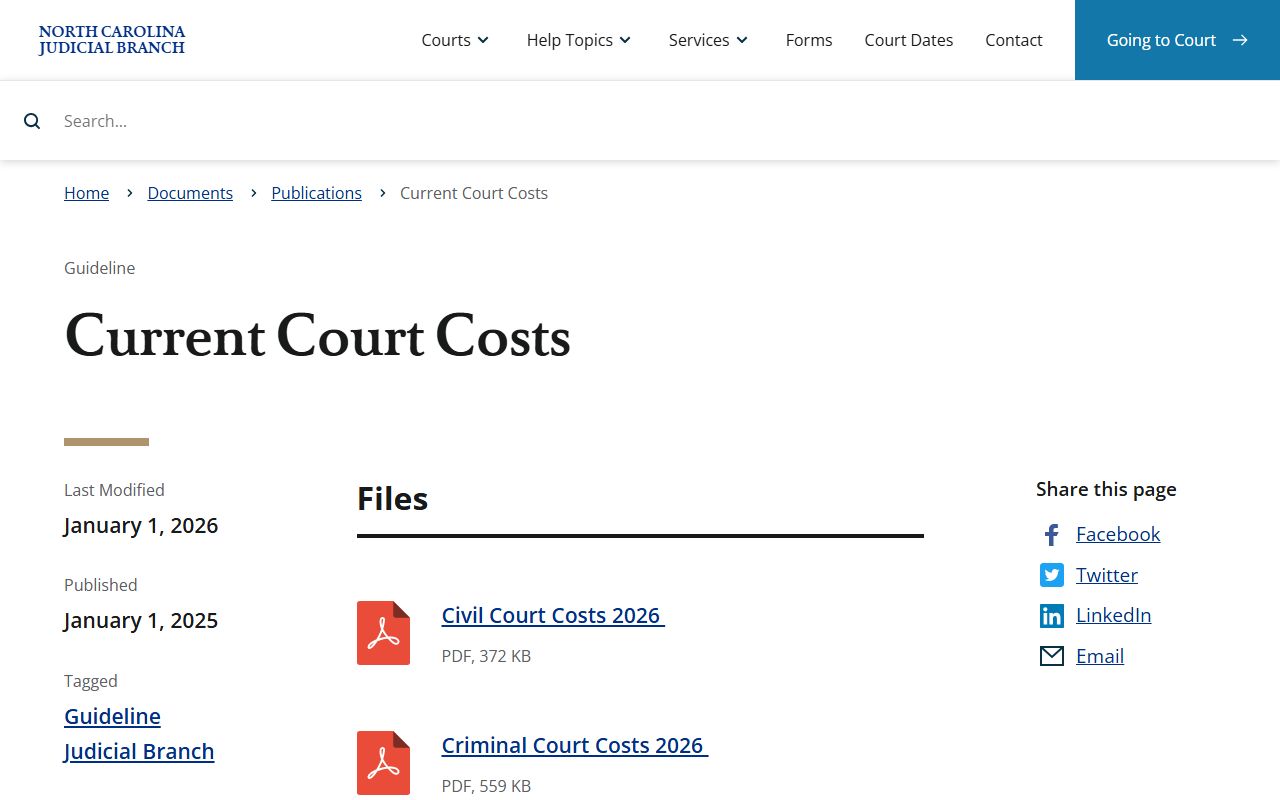
Cost charts help explain the payment side of a docket result, but they should be checked against the active case balance.
Read Harnett County Docket Entries
Reading Harnett County court dockets starts with the header. Confirm the county, division, date, time, and courtroom before relying on the party line. Then read the case number or file number, party or defendant name, offense or case type, and status fields. In criminal or traffic calendars, fields such as plea, verdict, class, and judgment may be blank until the court session is completed. A blank field is not proof that nothing happened later.
Common terms have specific meanings. A motion is a request for the court to rule. An order is the judge's direction. A judgment is a final or enforceable ruling. A disposition is the result of a charge or event. A continuance means a hearing was postponed. An arraignment is a criminal hearing where charges are addressed and a plea may be entered. These terms help separate a scheduled event from a final result.
Note: Always confirm a same-day hearing with the Clerk or division contact because docket schedules can change after online posting.
Harnett County Docket Updates
Harnett County's docket system is tied to the statewide eCourts rollout. NC Judicial Branch announced that eCourts went live in Harnett, Johnston, Lee, and Wake, bringing Portal, File & Serve, and Odyssey into local court operations. That matters for docket searches because Harnett was part of the early digital shift rather than a county waiting for later migration. It also means Portal access is a normal local records channel, not a special add-on.
The Harnett court news tag can show court-related updates, appointments, and local announcements.
Court news can help explain schedule or staffing changes that are not obvious from a single docket line.
The official eCourts launch announcement confirms Harnett's role in the Portal, Odyssey, and File & Serve rollout.
The launch context is useful when a docket search involves newer electronic case activity, online filings, or Portal hearing data.